Auxiliary Verb (Group 2) (Basic ㊦ 131)
Someone/something begins to do something or begins to be in some state.
Equivalent: Begin to
| Vます | はじめる | |
| 話しはじめる | Someone begins to talk | |
| 食べはじめる | Someone begins to eat |
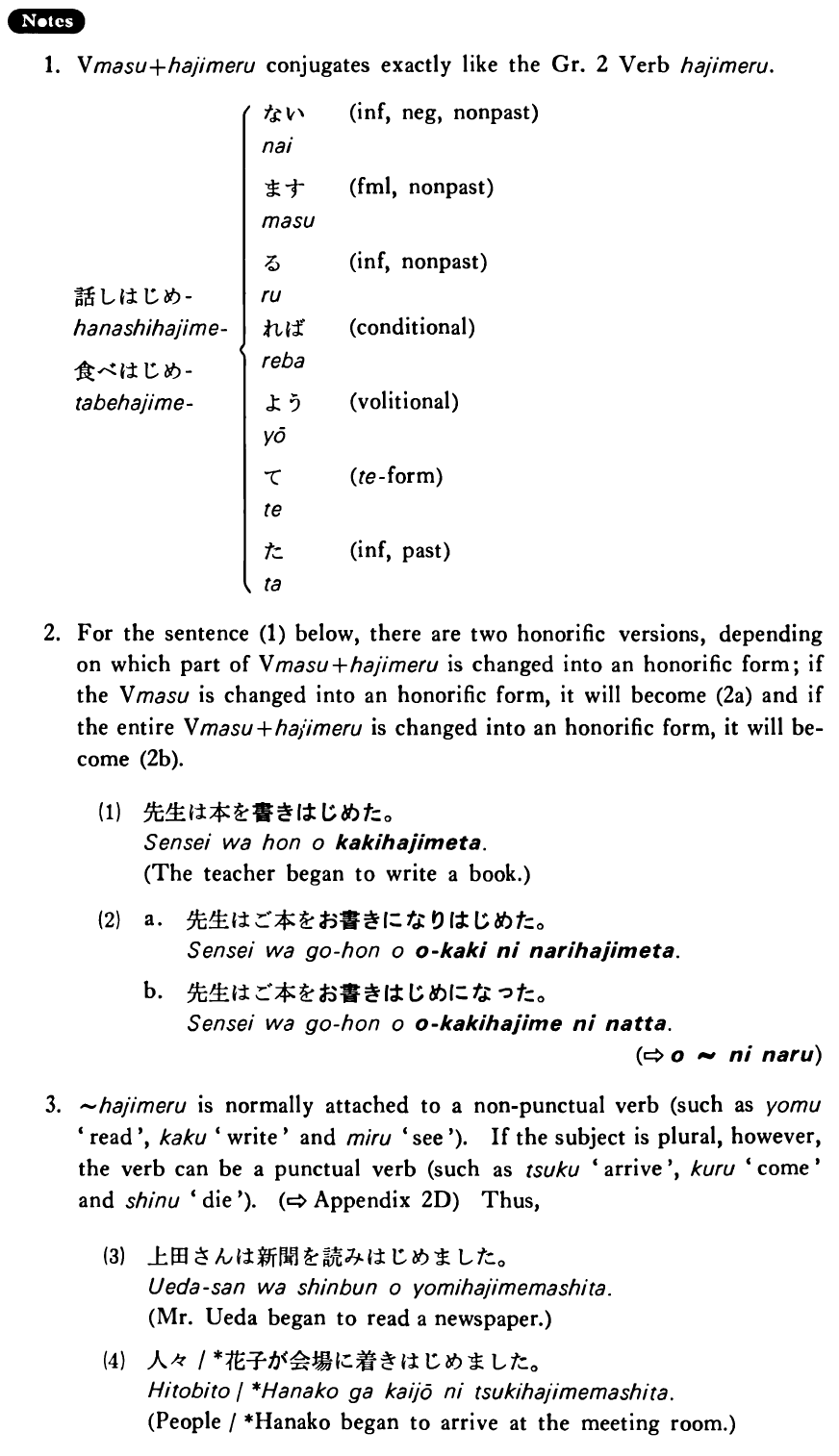
1. Verbます始める conjugates exactly like the Group 2 Verb 始める.
| ない | informal, negative, nonpast | |
| ます | formal, nonpast | |
| 話しはじめ | る | informal, nonpast |
| 食べはじめ | れば | conditional |
| よう | volitional | |
| た | て form | |
| た | informal, past |
2. For the sentence (1) below, there are two honorific versions, depending on which part of Verbます始める is changed into an honorific form; if the Verbます is changed into an honorific form, it will become (2a) and if the entire Verbます始める is changed into an honorific form, it will become (2b).
(⇨ お~になる)
3. 始める is normally attached to a non punctual verb (such as 読む 'read', 書く 'write' and 見る 'see'). If the subject is plural, however, the verb can be a punctual verb (such as 着く 'arrive', 来る 'come' and 死ぬ 'die'). Thus,